Custom software with AI: SMBs' next question is about data
SMBs are building apps in-house with AI and customer data ends up in several places. Why they need a small, shared system of record, and which tools to use.

Davide Ruggeri
SMBs have started building their own software
Until recently, a fifteen-person company that wanted custom management software had two options. It could pay a software house for months, or adapt to a SaaS that covered part of what it needed and make do with Excel for the rest.
Now there is a third way, and plenty of people are taking it. In its 2026 build vs buy report, Retool writes that 35% of the teams surveyed have already replaced at least one SaaS tool with something built in-house, and 78% plan to build more. The sample is made up of mid-sized and large companies, but the same thing is happening further down: The Information has reported on small businesses leaving Salesforce and HubSpot for apps written with Claude Code, Replit and Lovable.
I’m in the middle of this up to my neck. Over the past few months I’ve built myself a dashboard to manage projects, a tool for forms, one for email marketing and a few smaller ones. Each solves its own problem well. The trouble came later, when I started asking myself where the data had gone.
Many apps, many copies of the same customer
Every in-house app is born with its own database, its own login and its own idea of what a customer is. As long as there are one or two apps, nobody notices.
By the third, the same person exists in three places. They’re a lead in the tool that collects the site’s forms, a subscriber on the newsletter list and a customer in the invoicing software, each with its own email and their name spelled slightly differently. When they unsubscribe from the newsletter, the other two don’t know. When they buy, nobody records that the lead has become a customer.
It’s the same problem companies have always had with SaaS, with one difference: before, at least you were paying someone else for it. Now you created the copies that don’t talk to each other, and it’s up to you to keep them aligned.
Writing software is becoming cheaper and cheaper, and I think that’s exactly why more and more people will start asking where their data lives and which version is the right one.
The system of record, explained without jargon
There has been a name for this problem for decades: system of record. It’s the system that is authoritative for a certain kind of data. If two tools have two different emails for the same customer, the one in the system of record wins, and the others fall into line.
Large companies solve it with heavy infrastructure. They copy the data from all their apps into a data warehouse like Snowflake or BigQuery and from there send it back to the various tools through dedicated services. Canva, for example, uses Snowflake as the basis for its customer data, Fivetran to collect it, dbt to clean it and Census to send it back to its marketing tools.
It works, but behind it there’s a data team writing queries and maintaining pipelines. An SMB doesn’t have that team, and it makes no sense for it to hire one just to find out which contacts have become customers.
In Italian SMBs the system of record already exists, but nobody chose it
If I ask a business owner where the right version of their customer data lives, the answer is almost always one of these:
- the management software or the invoicing software;
- an Excel file kept by a single person, often the owner;
- the salesperson’s phone contacts;
- Mailchimp, the CRM or the site’s plugin, each with its own list.
The management software is usually the most reliable, but it only knows people who have already bought. Everything that comes before, such as the contact who arrived through the form, the person met at a trade fair or someone who is still thinking about it, ends up in the other places on the list, when it ends up anywhere at all.
How I picture it: a small core, shared by all the apps
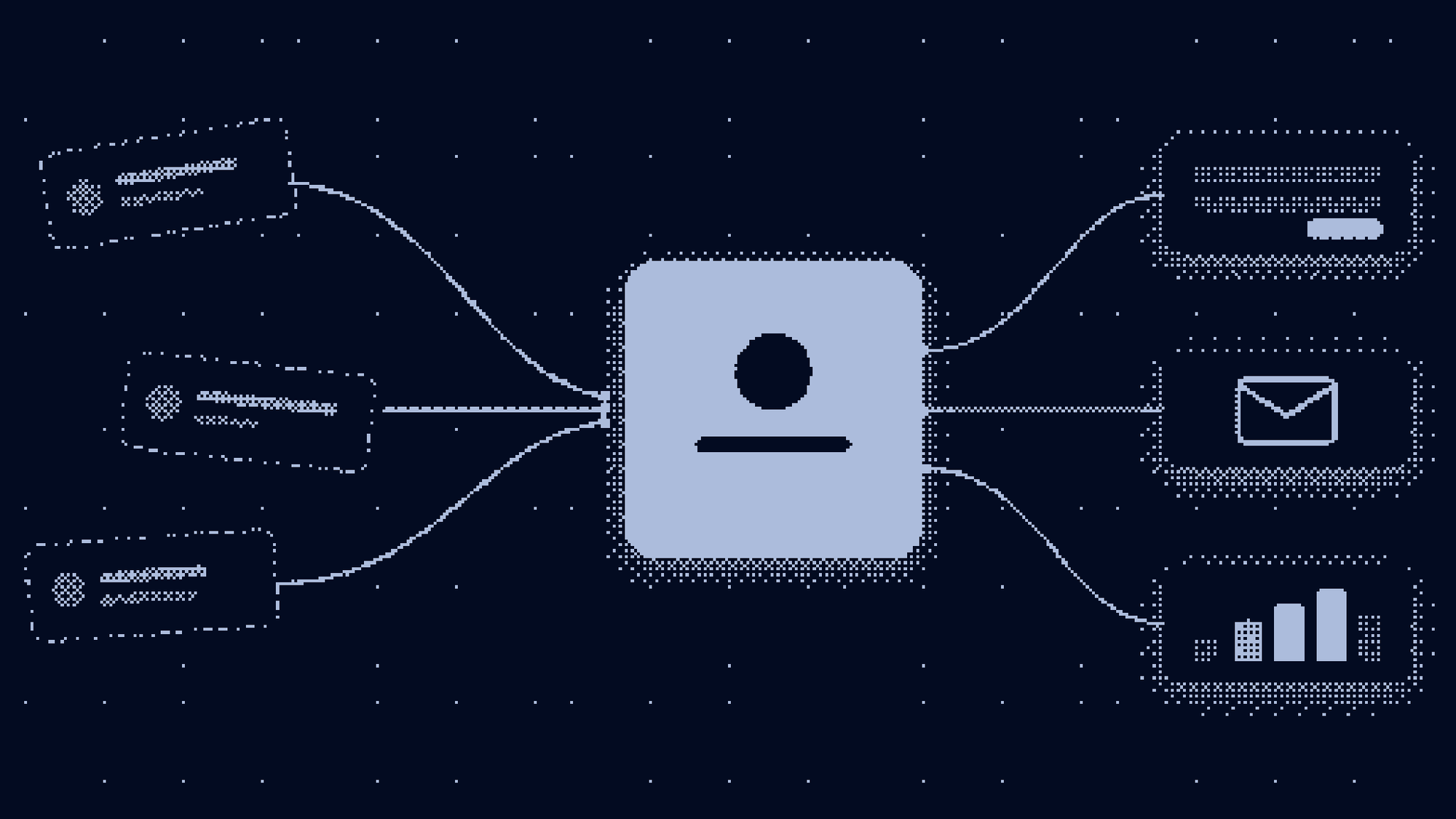
My idea is not a single database where every app writes whatever it wants. Each tool keeps its own data: the newsletter its campaigns, the dashboard its projects. Then there is a separate core with only the information that more than one app needs, that is, who people are, which companies they belong to, what consents they’ve given and where they came from.
The most important choice concerns the lead. Salesforce treats it as an object of its own: when it’s qualified, it converts it into a contact and an account, and the original record disappears from searches. HubSpot, on the other hand, keeps a single contact and changes its stage, from subscriber to lead to customer.
I side with HubSpot. A lead is not a thing, it’s the moment a person is at. If you save it as a separate entity, the day they buy you have to move it, and their history is split in two.
In practice the core has a few tables: people, organisations, the link between the two, and the stage of each with the history of changes. The apps are what move the stages: a form takes a person to lead, an imported invoice takes the company to customer. People, when needed, look at everything from a spreadsheet-like interface.
The tools already exist, the habit is missing
None of this requires new technology. The base is Postgres, which is already the database where almost all AI-written software ends up: according to Sacra, coding agents create about 70% of new Supabase databases every month. On top of it you can put NocoDB, which turns an existing database into something like Airtable.
Anyone who wants something more complete can find Twenty, an open source CRM that manages people, organisations and opportunities, with an extensible data model. The way I see it, it’s a system of record with a CRM interface already attached.
What’s missing, in my view, is just the habit of asking the question. Today you start from the app you need and think about the data afterwards, and that’s normal. As the number of apps in a company grows, I imagine the question will come by itself.
The questions that are coming
I believe that in the coming years many SMBs will have their own small ecosystem of apps, some built in-house and some custom-built by someone. And I believe that more and more people will sooner or later ask where their data lives and how to make the apps talk to each other.
If you’re working on a project and want to talk about it, tell us about your project.