
Google Ads for services: how much cash you need before a campaign pays back
Cost per lead is not enough to judge a Google Ads campaign for subscription services: how to work out the payback months and the cash you need to keep tied up.

Davide Ruggeri
· Updated November 20, 2026In recent weeks I ran a Google Ads campaign to find clients for my studio. It worked: people came in with a concrete need, ready to talk about a project.
Once I did the maths, though, I realised that cost per lead and the number of requests are not enough to judge it. A campaign can be profitable on paper and still need more cash, for longer, than you expect. It’s easy to mistake this wait for a campaign that doesn’t work. It’s not a reason not to run one: it’s a calculation to do as soon as the first data comes in, to know what you’re in for and decide how to proceed.
Profit and loss and cash: two different questions
The profit and loss account answers one question: will what I spend to find a client come back sooner or later? Cash answers another: when does it come back, and can I wait until then?
For someone who sells once, the two answers almost coincide. The client buys, pays, and the ad spend is recovered immediately or not at all.
For someone who sells subscription services, like my studio, the two answers come apart. You pay for advertising today, the client pays one month at a time. The profit arrives, but spread out, and in the meantime the money spent stays tied up.
My case in numbers
On the search network, 4% of clicks turned into a contact request. In practice each request cost as much as twenty-five clicks. With the budget I had set, about one a week came in.
If I close one contract for every four or five requests, finding a client costs roughly two months of their fee. A client who stays a year pays back what it cost to find them several times over. The profit and loss, then, holds up.
The cash doesn’t. Recovering the cost of one client takes a few months, and meanwhile the campaign keeps spending to find the next.
It takes little for the numbers to change. A client who stops after the first month pays back only about one request, and with one request a week a case like that weighs on the whole calculation.
The calculation to make with the first data
After a few weeks of campaign you have the data for three numbers:
What it costs to find a client: the cost of a request divided by the share of requests you close
How many months it takes to pay back: that cost divided by what a client leaves you each month
For how many months you can keep that spend tied up without running short elsewhere
The closing rate is the last figure to arrive. While contracts are few, it’s better to reason on a range of scenarios, as in the chart further on, and update it with every client closed.
The second number, for a single client, is calculated like this:
months to pay back = cost of a request ÷ (closing rate × monthly fee × margin)
The margin is the part of the fee you keep after paying for what it takes to serve the client: hours of work valued at hourly cost, hosting, licences, dedicated tools. Using the full fee makes the payback look faster than it is.
In my case a request cost a little under half a month’s fee. With one client for every eight requests and a 50% margin, which here is an example assumption and not the studio’s real figure, and clients who stay 18 months on average, each client pays back in about 8.9 months: more than twice the 3.9 you would get with the full fee.
If the second number is smaller than the third, the campaign holds up in terms of cash too. If it’s larger, the campaign may work anyway, but it needs more cash than you have budgeted for: you can budget for it, lower the budget or work on the levers that shorten the wait.
There is a detail the calculation doesn’t show: with small volumes the average counts for little. One client in ten who stops after a month disappears into the average. Two in ten, and the result changes.
The formula holds for one client at a time. But a campaign doesn’t stop after the first: while you wait for it to pay back, it keeps spending to find the next. That is why the cash of the whole campaign comes back later than that of a single client.
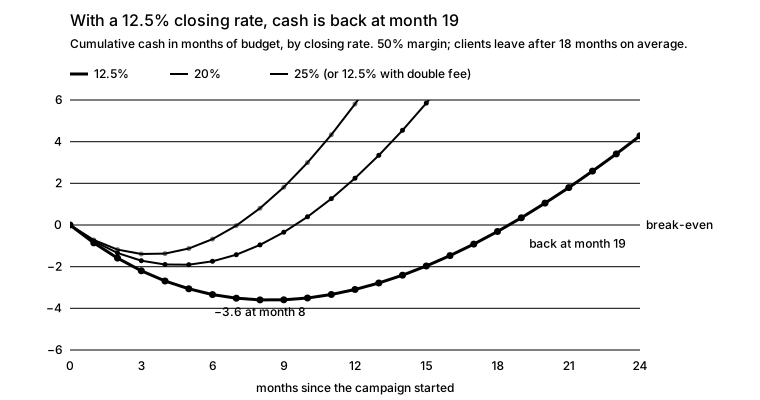
With one client for every eight requests, the same 50% margin and clients who stay 18 months on average, the lowest point comes in the eighth month, with about 3.6 months of budget tied up, and break-even in the nineteenth. That lowest point, not the monthly budget, is the number to compare with the cash you can keep tied up.
You can redo the same calculation with your own numbers in the Google and Meta Ads payback calculator.
How to shorten the wait
The formula has three levers, and they don’t weigh the same.
The cost of a request. It’s the lever people work on most, and the one with the least room. Mine was already in line with the average for business services in the WordStream benchmarks
The closing rate. Going from one client in eight requests to one in four halves the months to pay back. It depends on what happens after the request: the first call, the proposal, how convinced the contact already is
The client’s value in the first months. In the chart the line “1 in 8 with double fee” coincides with “1 in 4”: doubling what you collect from a client is worth as much as doubling the contracts closed. A higher fee, or an initial project paid at signing, shortens the wait without touching the campaign. An initial project paid at signing often has a different margin from the fee, so it shortens the wait more than the amount alone suggests
The budget, on the other hand, shortens nothing. With the same rates everything doubles, including the cash tied up at the lowest point. What changes is stability: with more clients a month, one who stops early gets lost in the average instead of shifting the whole calculation.
A decision made with numbers
The cost per lead of the first weeks tells you whether a campaign brings the right people. It doesn’t tell you whether you can afford it: for that you need the payback months and the cash you’re willing to keep tied up.
With these numbers in hand, keeping a campaign running, slowing it down or stopping it become reasoned choices, not a reaction to a month that went worse than expected. A campaign that asks for six months of patience simply has to be funded for six months, or postponed until you can do so.