
A private area on a subdomain: why keep it apart from the site
An association only wanted a new look, but its public site and members' area lived in the same files. Why a real private area belongs on a separate subdomain, and when it doesn't.

Davide Ruggeri
A few months ago an agency asked me for a quote on behalf of one of its clients, a trade association with a private area for its members. The request was to give the site a new look and leave everything else as it was, so the office staff could keep working as usual.
Before quoting I wanted to look at what was underneath. The public site and the members’ area lived in the same application and the same files, to the point that redoing the design meant touching the code that decides who can get in where.
I took one conviction away from that project: when an organisation has a real private area, it should live at an address of its own. A subdomain, separate from the site.
One site, two different jobs
The public site has to be found and has to convince whoever arrives: who the association is, what it offers, why join. The private area has to let the right people in, give them what they are entitled to and keep everyone else out.
They are two products with different audiences. Anyone reads the first, often arriving from Google, and it changes with communication: a campaign, an event, a redesign every few years. The second is used by members and office staff, and it changes with the association’s rules: fees, renewals, documents, who can see what.
As long as they live in the same container, every change to one risks touching the other.
What happens when they live together
On the association’s site, the part that was meant to deal only with appearance also decided who could enter the members’ area, where to send them after login and what to show them. Changing the design, as the brief asked, would have broken the separation between the areas.
There was also a security cost. When the site and the private area are the same thing, a mistake in one opens the other too. In this case I found a couple of very serious ones, and reported them straight away.
And there was a cost in clarity. The affiliated schools appeared in four different places, the members’ area had been built twice, and the office never knew for sure which version to update.
It is nobody’s fault in particular. It happens to sites that grow by additions: you need a members’ area and you put it inside the site, you need a search and it ends up there too. Each choice makes sense on its own, and after a few years the showcase site is holding up half the association.
Why a subdomain
The solution I would propose is simple to explain: the public site stays at www.associazione.it, the private area moves to soci.associazione.it. Same brand, same colours, shared login if needed. Behind them, two distinct applications.
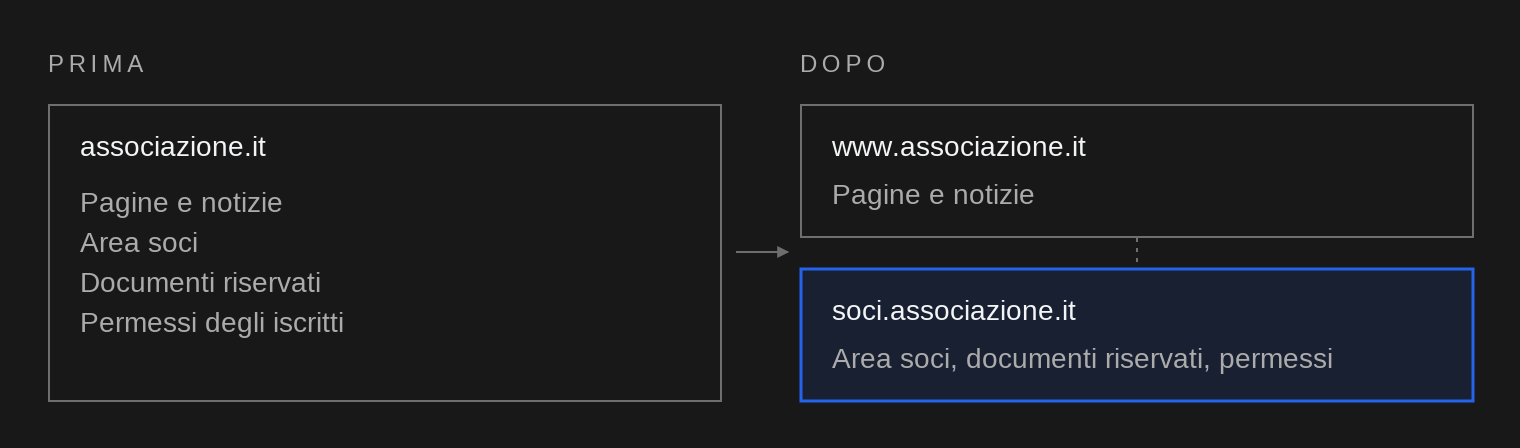
What changes in practice:
the public site can be redone whenever needed, even from scratch, without touching members, documents and permissions
a problem in one of the two stays confined there and does not open the door to the other
each one gets the right tool: a lightweight CMS for the public pages, a proper management system for the members
the office knows where it works: news is published on the site, members and materials are managed in the members’ area
for members, the private area becomes a recognisable place, with an address to save in their bookmarks
The boundary becomes visible even to those who don’t write code. When someone asks for a change, the first question is which of the two addresses it goes on, and the answer is usually obvious.
When you don’t need it
If the private area is a page with three password-protected PDFs, a subdomain is too much. Just keep it simple and tidy inside the site.
Things change when the members’ area starts to have a life of its own: different roles for different types of membership, fees to pay, renewals, course registrations, a directory of professionals. At that point it is no longer a section of the site but a small management system, and treating it like one more page is the fastest way to end up in the situation I described above.
Before redoing the site
If your organisation has a private area and you are thinking about a redesign, I would ask these questions of whoever manages the site today:
if we change the design, what stops working in the members’ area?
who decides what each member can see, and where are these rules written?
does the same content exist in more than one place?
could we move the members’ area to an address of its own without breaking anything?
If the answers are vague, the new design can wait. First it is better to decide where the site ends and where the private area begins.
Have a project in mind? Tell us about it here.